Unlocking Knowledge: Professional Perspectives on Pakistan’s Open Access Institutional Repositories
DOI:
https://doi.org/10.5281/zenodo.15692946Keywords:
Open Access Institutional Repositories, Scholarly Communication, Information Dissemination, Library Professionals in Pakistan, Repository Awareness and AdoptionAbstract
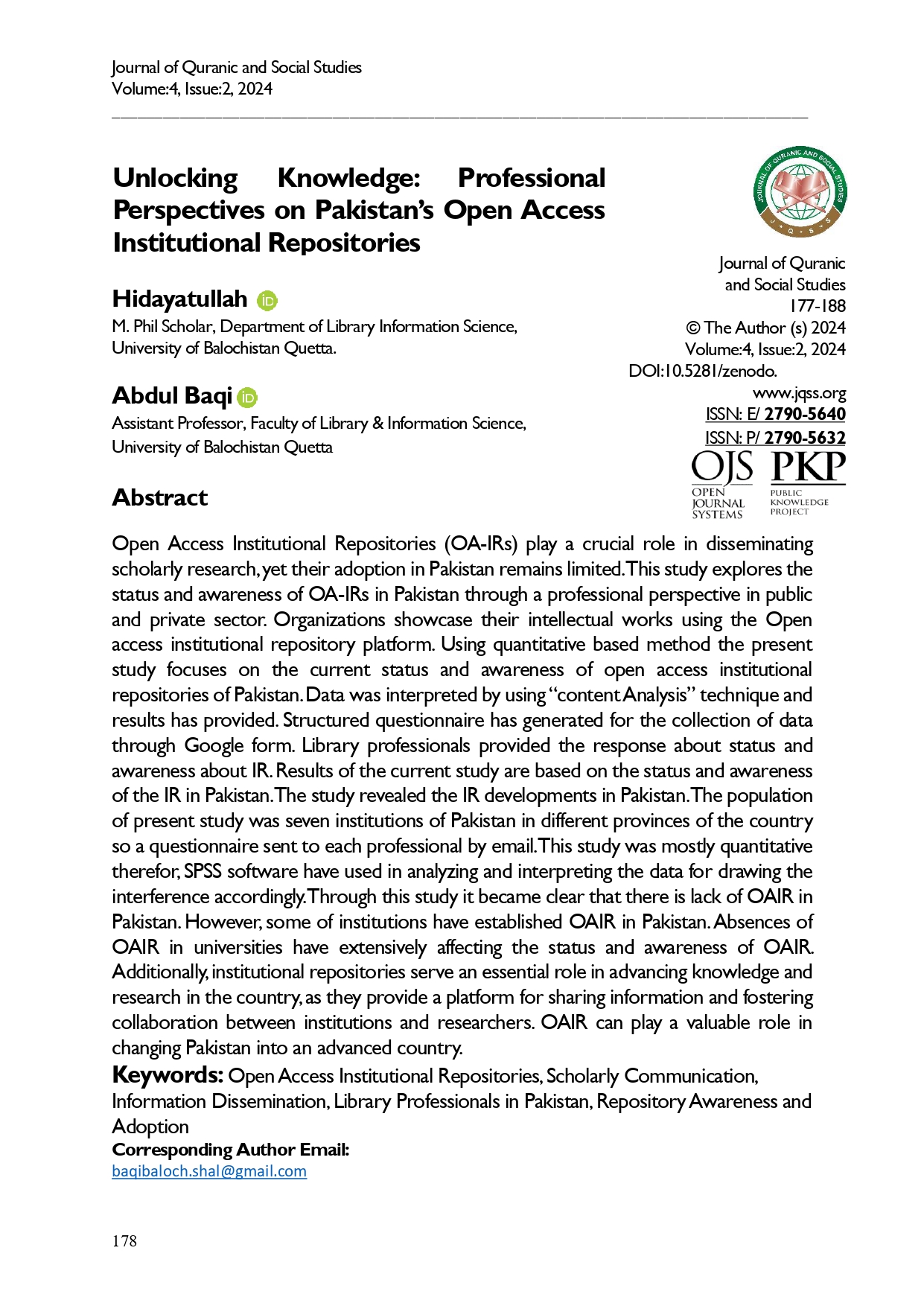
Open Access Institutional Repositories (OA-IRs) play a crucial role in disseminating scholarly research, yet their adoption in Pakistan remains limited. This study explores the status and awareness of OA-IRs in Pakistan through a professional perspective in public and private sector. Organizations showcase their intellectual works using the Open access institutional repository platform. Using quantitative based method the present study focuses on the current status and awareness of open access institutional repositories of Pakistan. Data was interpreted by using “content Analysis” technique and results has provided. Structured questionnaire has generated for the collection of data through Google form. Library professionals provided the response about status and awareness about IR. Results of the current study are based on the status and awareness of the IR in Pakistan. The study revealed the IR developments in Pakistan. The population of present study was seven institutions of Pakistan in different provinces of the country so a questionnaire sent to each professional by email. This study was mostly quantitative therefor, SPSS software have used in analyzing and interpreting the data for drawing the interference accordingly. Through this study it became clear that there is lack of OAIR in Pakistan. However, some of institutions have established OAIR in Pakistan. Absences of OAIR in universities have extensively affecting the status and awareness of OAIR. Additionally, institutional repositories serve an essential role in advancing knowledge and research in the country, as they provide a platform for sharing information and fostering collaboration between institutions and researchers. OAIR can play a valuable role in changing Pakistan into an advanced country.
Downloads
References
1) Ahmad, A., Asad, I. H., & Khan, H. (2023). Developing of Institutional Repository in Public Sector University Libraries of Punjab, Pakistan. Journal of Information Management and Practices, 3(1).
2) Ali, M. Y., & Richardson, J. (2017). Pakistani LIS scholars’ altmetrics in ResearchGate. Program, 51(2), 152-169.
3) Asadi, S., Abdullah, R., Yah, Y., & Nazir, S. (2019). Understanding Institutional Repository in Higher Learning Institutions: A systematic literature review and directions for future research. IEEE Access, 7, 35242-35263.
4) Barton, M. R., & Waters, M. M. (2004). Creating an institutional repository: LEADIRS workbook.
5) Bhandi, M. K., & Vishala, B. K. (2007). Building institutional repository (IR): Role of the library.
6) Chan, L., Kirsop, B., & Arunachalam, S. (2005). Open access archiving: the fast track to building research capacity in developing countries.
7) Demetres, M. R., Delgado, D., & Wright, D. N. (2020). The impact of institutional repositories: a systematic review. Journal of the Medical Library Association: JMLA, 108(2), 177.
8) Dulle, F. W., & Minishi-Majanja, M. K. (2009). Researchers' perspectives on open access scholarly communication in Tanzanian public universities. South African Journal of Information Management, 11(4), 1-14.
9) Gargouri, Y., Hajjem, C., Larivière, V., Gingras, Y., Carr, L., Brody, T., & Harnad, S. (2010). Self-selected or mandated, open access increases citation impact for higher quality research. PloS one, 5(10), e13636.
10) Higher Education Commission. (2022). Annual report 2021–22. Higher Education Commission of Pakistan. https://www.hec.gov.pk/english/news/AnnualReports/Annual%20Report%202021-22.pdf
11) Hussain, M., Ali, K., & Jan, R. (2025). Technology management competencies of library and information science professionals: insights from Pakistan. Information Discovery and Delivery.
12) Khokhar, M. T., Rafiq, M., & Malik, A. (2023). Open access (OA) publishing behavior of university faculty members from the perspective of decomposed theory of planned behavior (DTPB). Global Knowledge, Memory and Communication.
13) Lynch, C. A. (2003). Institutional repositories: essential infrastructure for scholarship in the digital age. portal: Libraries and the Academy, 3(2), 327-336.
14) Mirza, K. B., Arif, M., Ullah, M., & Hamid, M. (2024). Unlocking Scholarly Access Beyond Boundaries: Strategies, Lessons, and Challenges in Implementing an Institutional Repository at Quaid I Azam University Library, Pakistan. International Information & Library Review, 56(4), 335-351.
15) Piwowar, H., Priem, J., Larivière, V., Alperin, J. P., Matthias, L., Norlander, B., ... & Haustein, S. (2018). The state of OA: a large-scale analysis of the prevalence and impact of Open Access articles. PeerJ, 6, e4375.
16) Puspita, D., Roisah, K., & Lestari, S. N. (2024). Open Access Institutional Repository in the Digital Era: Preventing or Increasing Plagiarism?. Yustisia, 13(2), 168-188.
17) Rafiq, M. (2022). Institutional repositories (IRs) in universities of Pakistan: Issues and emergent framework for remedies. The Journal of Academic Librarianship, 48(1), 102480.
18) Rafiq, M., Ameen, K., & Jabeen, M. (2018). Barriers to digitization in university libraries of Pakistan: A developing country’s perspective. The Electronic Library, 36(3), 457-470.
19) Siddique, N., & Mahmood, K. (2015). Status of library software in higher education institutions of Pakistan. International Information & Library Review, 47(3-4), 59-65.
20) Suber, P. (2012). Open access (p. 256). The MIT Press.
Downloads
Published
How to Cite
Issue
Section
License
Copyright (c) 2024 Author

This work is licensed under a Creative Commons Attribution-NonCommercial 4.0 International License.