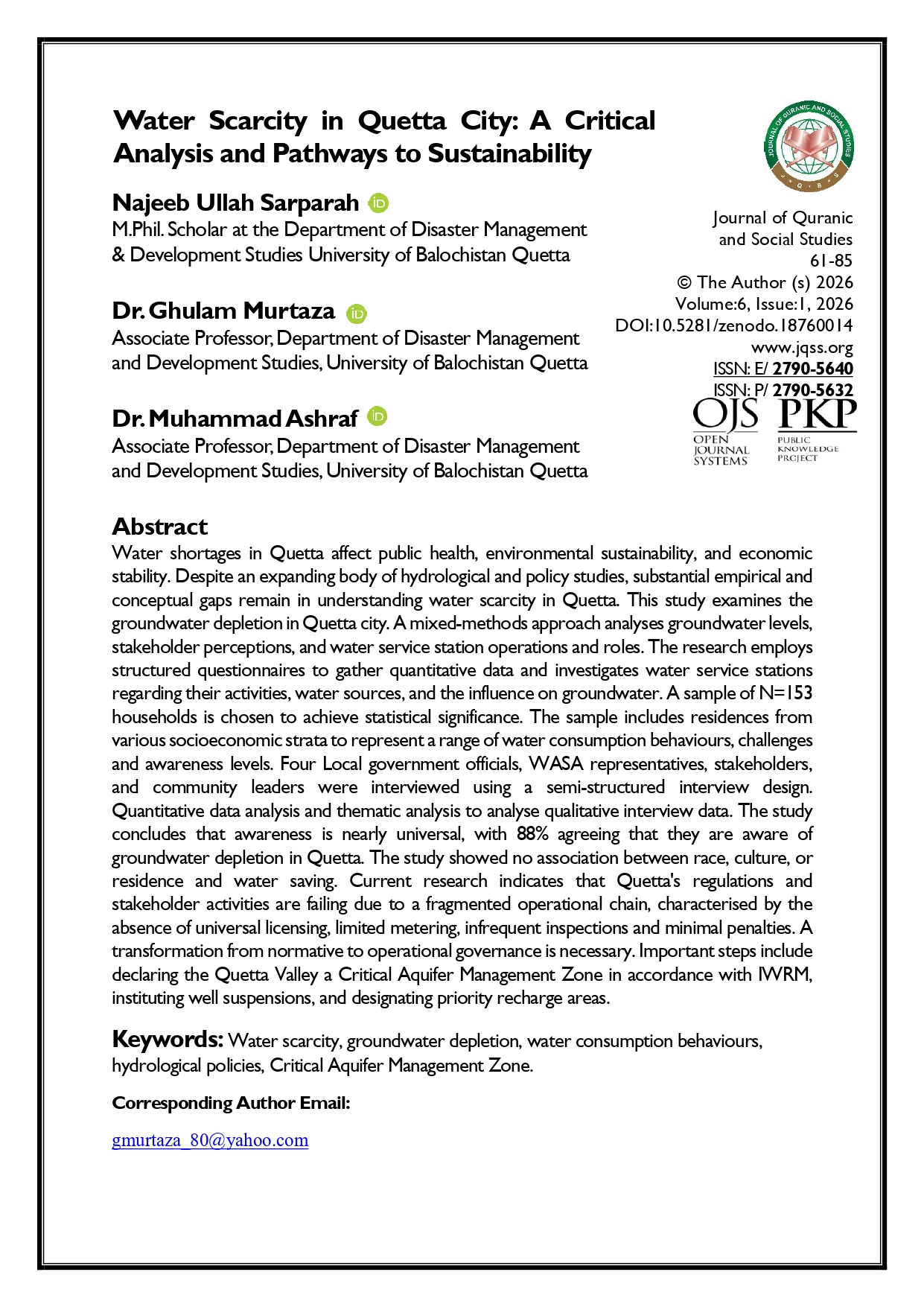
Water Scarcity in Quetta City: A Critical Analysis and Pathways to Sustainability
DOI:
https://doi.org/10.5281/zenodo.18760014Keywords:
Water scarcity, groundwater depletion, water consumption behaviours, hydrological policies, Critical Aquifer Management Zone.Abstract
Water shortages in Quetta affect public health, environmental sustainability, and economic stability. Despite an expanding body of hydrological and policy studies, substantial empirical and conceptual gaps remain in understanding water scarcity in Quetta. This study examines the groundwater depletion in Quetta city. A mixed-methods approach analyses groundwater levels, stakeholder perceptions, and water service station operations and roles. The research employs structured questionnaires to gather quantitative data and investigates water service stations regarding their activities, water sources, and the influence on groundwater. A sample of N=153 households is chosen to achieve statistical significance. The sample includes residences from various socioeconomic strata to represent a range of water consumption behaviours, challenges and awareness levels. Four Local government officials, WASA representatives, stakeholders, and community leaders were interviewed using a semi-structured interview design. Quantitative data analysis and thematic analysis to analyse qualitative interview data. The study concludes that awareness is nearly universal, with 88% agreeing that they are aware of groundwater depletion in Quetta. The study showed no association between race, culture, or residence and water saving. Current research indicates that Quetta's regulations and stakeholder activities are failing due to a fragmented operational chain, characterised by the absence of universal licensing, limited metering, infrequent inspections and minimal penalties. A transformation from normative to operational governance is necessary. Important steps include declaring the Quetta Valley a Critical Aquifer Management Zone in accordance with IWRM, instituting well suspensions, and designating priority recharge areas.
Downloads
References
1. Accountability Lab Pakistan. (2025). Policy brief: Water governance challenges in Pakistan. https://pakistan.accountabilitylab.org/wp-content/uploads/2025/02/Policy-Brief-English-Water-Governance-in-Pakistan.pdf
2. Aftab, S. M., Siddiqui, R. H., & Farooqui, M. A. (2018). Strategies to Manage Aquifer Recharge in Balochistan, Pakistan: An Overview. IOP Conference Series: Materials Science and Engineering, 414 (1). https://doi.org/10.1088/1757-899X/414/1/012023
3. Asian Development Bank. (2025). Balochistan Water Resources Development Sector Project: Semi-annual monitoring report (Jul–Dec 2024). https://bwrdsp.gob.pk/wp-content/uploads/2025/04/9th-SMR-Jul-Dec-2024.pdf
4. Aslam Khan, K. (2023). Water Scarcity in Balochistan and Its Impact on Its Agriculture. Journal of Public Policy Practitioners, 1(1). https://doi.org/10.32350/jppp.11.01
5. Balochistan Council for Science & Water. (2024). Balochistan Integrated Water Resources Management Policy 2024. https://bcsw.balochistan.gov.pk/wp-content/uploads/2025/03/Balochistan-Water-policy-2024.pdf
6. Balochistan Ground Water Right Administration Ordinance. (1978). Government of Balochistan. https://balochistancode.gob.pk/lawdir/a309305b-7abd-485d-81ca-e01db0a1df4b.pdf
7. Balochistan Integrated Water Resources Management Policy. (2024). Government of Balochistan. https://bcsw.balochistan.gov.pk/wp-content/uploads/2025/03/Balochistan-Water-policy-2024.pdf
8. Barech, S., & Ainuddin, S. (2019). The Impact Of Water Scarcity On Women In Rural Area In Quetta. Pakistan Journal of Gender Studies, 18(1), 129–143. https://doi.org/10.46568/pjgs.v18i1.29
9. Barrech, S., Ainuddin, S., & . N. (2018). Multi-Dimensional Implication of Water Scarcity on Inhibitants of District Quetta, Balochistan, Pakistan. Journal of Environmental Science and Public Health, 02(03), 136–143. https://doi.org/10.26502/jesph.96120033
10. Durrani, I. H., Adnan, S., & Aftab, S. M. (2018). Historical and Future Climatological Drought Projections over Quetta Valley, Balochistan, Pakistan. IOP Conference Series: Materials Science and Engineering, 414(1). https://doi.org/10.1088/1757-899X/414/1/012043.
11. Elgaali, E., & Akram, M. (2021). Recycling and Reuse of Wastewater Generated in Car-Washing Facilities. Adv. Sci. Technol. Eng. Syst. J, 6, 521-525.
12. Foster, S. S. D., & Chilton, P. J. (2003). Groundwater: the processes and global significance of aquifer degradation. Philosophical Transactions of the Royal Society of London. Series B: Biological Sciences, 358(1440), 1957-1972.
13. Government of Balochistan. (2004). Quetta Water & Sanitation Authority Act (Baln Act XII of 2004). https://balochistan.gov.pk/wp-content/uploads/2024/10/Quetta-WASA-Act-2004-1.pdf
14. Government of Balochistan. (2024). Balochistan Integrated Water Resources Management Policy 2024. https://bcsw.balochistan.gov.pk/wp-content/uploads/2025/03/Balochistan-Water-policy-2024.pdf
15. Government of Pakistan, Ministry of Water Resources. (2018). National Water Policy 2018.https://www.mowr.gov.pk/SiteImage/Misc/files/National%20Water%20Policy.pdf
16. Jafari, S. B., NABI, B. G. R., Salemi, A., Taherioun, M., & Ardestani, M. (2008). Water quality assessment of Gheshlagh River using water quality indices. Advanced Environmental Sciences, 6(4).
17. Kakar, Z., & Ahmad, M. (2016). Study on The Causes of Water Scarcity in Pishin Lora Basin of Balochistan. Journal of Applied and Emerging Sciences, 135-140.
18. Kakar, N., Kakar, D. M., & Barrech, S. (2020). Land subsidence caused by groundwater exploitation in Quetta and surrounding region, Pakistan. Proceedings of the International Association of Hydrological Sciences, 382, 595–607. https://doi.org/10.5194/piahs-382-595-2020
19. Kakar, N., Kakar, D. M., & Barrech, S. (2020). Land subsidence caused by groundwater exploitation in Quetta and surrounding region, Pakistan. Proceedings of the International Association of Hydrological Sciences, 382(October), 595–607. https://doi.org/10.5194/piahs-382-595-2020
20. Kakar, N., Zhao, C., Li, G., & Zhao, H. (2024). GNSS and Sentinel-1 InSAR Integrated Long-Term Subsidence Monitoring in Quetta and Mastung Districts, Balochistan, Pakistan. Remote Sensing, 16(9), 1521.
21. Kakar, Z., Shah, S. M., & Khan, M. A. (2018). Scarcity of water resources in rural area of Quetta District; Challenges and preparedness. IOP Conference Series: Materials Science and Engineering, 414(1). https://doi.org/10.1088/1757-899X/414/1/012013
22. Khair, S. M., Mushtaq, S., & Reardon‐Smith, K. (2015). Groundwater governance in a water‐starved country: public policy, farmers' perceptions, and drivers of tubewell adoption in Balochistan, Pakistan. Groundwater, 53(4), 626-637.
23. Khair, S. M., Mushtaq, S., Culas, R. J., & Hafeez, M. (2012). Groundwater markets under the water scarcity and declining watertable conditions: The upland Balochistan Region of Pakistan. Agricultural Systems, 107, 21-32.
24. Khan, A. S., Khan, S. D., & Kakar, D. M. (2013). Land subsidence and declining water resources in Quetta Valley, Pakistan. Environmental Earth Sciences, 70(6), 2719–2727. https://doi.org/10.1007/s12665-013-2328-9
25. Khan, F. A., Ahmad, S. F., Saeed, S., Ullah, A., & Mahmood, S. (2025). Groundwater depletion in Quetta: Satellite-based climate impact analysis (2002–2023). Spectrum of Engineering Sciences, 8. https://sesjournal.com/index.php/1/article/view/818
26. McDonald, R. I., Green, P., Balk, D., Fekete, B. M., Revenga, C., Todd, M., & Montgomery, M. (2011). Urban growth, climate change, and freshwater availability. Proceedings of the National Academy of Sciences, 108(15), 6312–6317. https://doi.org/10.1073/pnas.1011615108
27. MDPI—Remote Sensing. (2024). GNSS and Sentinel-1 InSAR integrated long-term subsidence monitoring in Quetta and Mastung. https://www.mdpi.com/2072-4292/16/9/1521
28. Mekonnen, M. M., & Hoekstra, A. Y. (2016). Four billion people facing severe water scarcity. Science Advances, 2(2), e1500323. https://doi.org/10.1126/sciadv.1500323
29. Ministry of Water Resources, Government of Pakistan. (2018). National Water Policy. https://www.mowr.gov.pk/SiteImage/Misc/files/National%20Water%20Policy.pdf
30. Mohammad, A. D., & Rind, R. F. (2020). An application of WQI and correlation matrix to evaluate groundwater quality around brick kilns of Loralai District Balochistan. Journal of Asian Scientific Research, 10(2), 88.
31. Naz, F., Dars, G. H., Ansari, K., Jamro, S., & Krakauer, N. Y. (2020). Drought trends in Balochistan. Water (Switzerland), 12(2). https://doi.org/10.3390/w12020470
32. Ostrom, E. (2009). A general framework for analyzing sustainability of social-ecological systems. Science, 325(5939), 419–422. https://doi.org/10.1126/science.1172133
33. Pahl-Wostl, C. (2007). Transitions towards adaptive management of water facing climate and global change. Water Resources Management, 21(1), 49–62. https://doi.org/10.1007/s11269-006-9040-4
34. Pakistan Council of Research in Water Resources (PCRWR). (2024). Annual Report 2023–24. https://pcrwr.gov.pk/wp-content/uploads/2024/09/Annual-Report-2023-24.pdf
35. PCRWR. (2016). Groundwater management in Balochistan, Pakistan. https://pcrwr.gov.pk/wp-content/uploads/2021/06/Groundwater-Management-in-Balochistan-Pakistan-2016.pdf
36. PCRWR. (n.d.). Quetta Water Resources Research Centre: Artificial recharge and efficiency pilots. https://www.pcrwr.gov.pk/quetta/
37. Quetta Water and Sanitation Authority Act. (2004). Government of Balochistan. https://balochistan.gov.pk/wp-content/uploads/2024/10/Quetta-WASA-Act-2004-1.pdf
38. Qureshi, A. L., Jamali, M. A., Hussain, S., Memon, F. A., Zaidi, A. Z., Zafar, S., … Ahmed, W. (2022). Subsurface depleting aquifers in the sedimentary terrain of Quetta Valley in Balochistan: A review. Arabian Journal of Geosciences, 15, 1648. https://doi.org/10.1007/s12517-022-10930-9
39. Razzaq, A., Xiao, M., Zhou, Y., Anwar, M., Liu, H., & Luo, F. (2022). Towards sustainable water use: Factors influencing farmers’ participation in the informal groundwater markets in Pakistan. Frontiers in Environmental Science, 10, 944156.
40. Rijsberman, F. R. (2006). Water scarcity: Fact or fiction? Agricultural Water Management, 80(1–3), 5–22. https://doi.org/10.1016/j.agwat.2005.07.001
41. UNDP Pakistan. (2019, Jun 14). UNDP inaugurates water recycling plant at a car service station in Balochistan (Byco/Quetta). https://www.undp.org/pakistan/press-releases/undp-inaugurates-water-recycling-plant-car-service-station-balochistan
42. WHO/UNICEF JMP. (2021). Pakistan (Balochistan) MICS 2019–20: WASH service inequalities. https://washdata.org/reports/pakistan-balochistan-province-2019-20-mics-report
43. WWF-Pakistan. (2024). Policy brief: Improving Pakistan’s urban water management and governance. https://wwfasia.awsassets.panda.org/downloads/policy-brief-for-urban-water-governance.pdf
Downloads
Published
How to Cite
Issue
Section
License
Copyright (c) 2026 Author

This work is licensed under a Creative Commons Attribution-NonCommercial 4.0 International License.